

Which position is best for your agitation system? Vertical or horizontal, roof or bottom of the tank
The position of the equipment is a key parameter when choosing an agitation system. Whether we are talking about a vertical bottom mixer, a pendulum agitator for tank roofs or a horizontal mixer, each configuration meets a specific technical objective.
AGITEC® offers professionals in industrial mixing – in the chemical, food, cosmetics and water treatment industries – a technical and comparative analysis of vertical, horizontal and pendulum positions, in relation to their uses, advantages and limitations.
Understanding the challenges of choosing an industrial mixer
Choosing an industrial agitation system requires mastery of several technical parameters.
The position of the equipment affects:
- the hydraulic effect of the flows,
- the expected mixing effect,
- the shear rate,
An overview of mixers, agitators and blenders
The mixer is a piece of equipment designed for a specific recipe or versatile for homogenising different liquids or liquids/solids, for example. The agitator is defined as a rotating shaft equipped with one or more moving parts that create a targeted flow within at least one fluid. The mixer, on the other hand, is designed to mix pasty, dense or highly viscous products.
The choice of position influences the mixing effect, hence its importance.
Why is the position of the mixer a key performance factor?
The position influences:
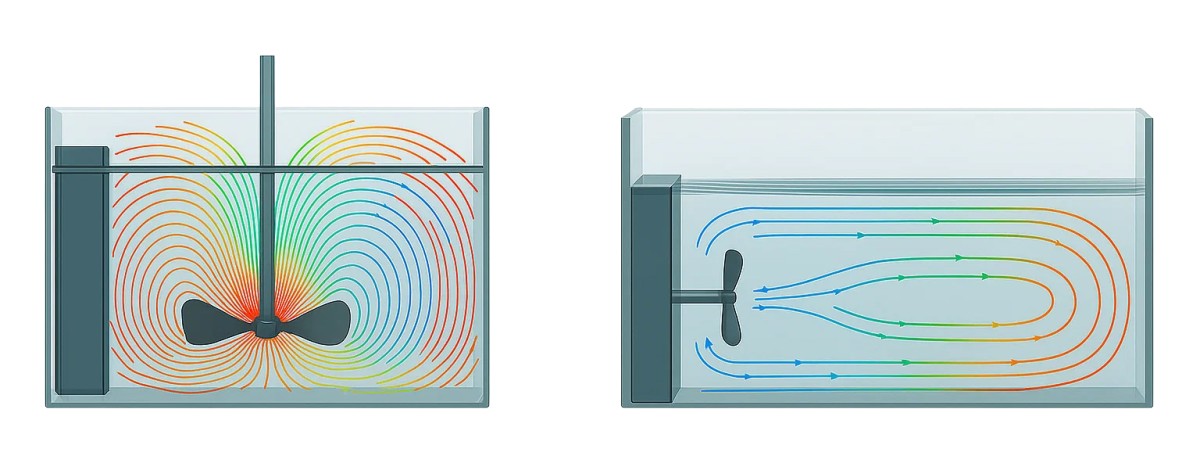
- The type of flow generated (axial, radial),
- The diffusion effect of the mixing dynamics throughout the entire volume,
- The mixing regime according to the viscosity of the fluid (from laminar to turbulent),
- The calculation of the tank and its dimensions,
- Accessibility for maintenance,
- The complexity of the cleaning process (CIP).
Each position offers a mechanical and hydraulic response adapted to a production profile.
Vertical mixers, agitators and kneaders
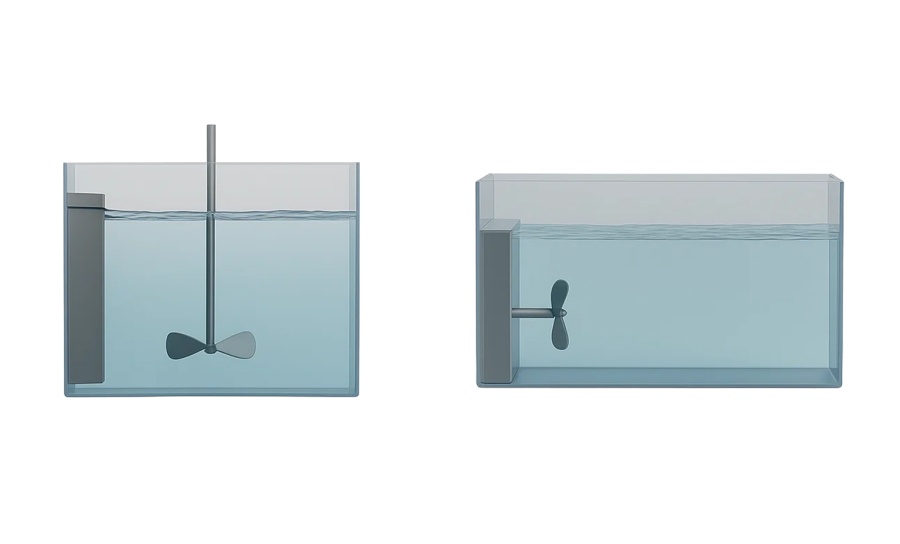
Vertical axis equipment is particularly common in manufacturing tanks. It is usually integrated to facilitate maintenance. These systems promote homogeneous diffusion and distribution of the mixing dynamics.
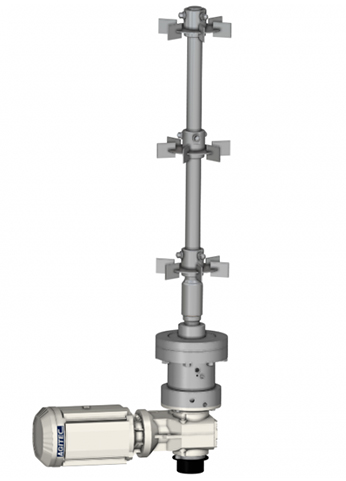
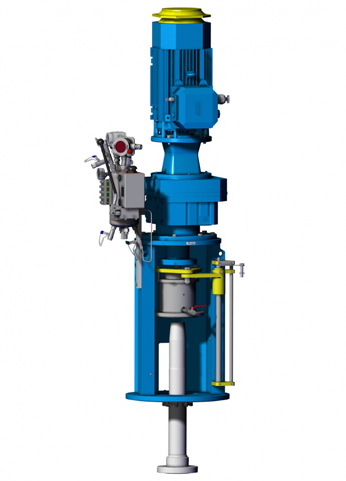
Example of a tank roof agitator:
AG-T EXT-LAT
Example of a tank bottom agitator:
AGF-R COMPACT
Features and principles of a vertical agitator
The vertical axis allows integration on the tank roof or the bottom of the tank. Depending on the agitation mechanism used, the flow can be axial, radial or hybrid. This type of agitator is suitable for stabilising a chemical reaction, optimising heat exchange or suspension, for example. This type of agitator is particularly suitable for cylindrical tanks, even those with a large height, ensuring stable mixing throughout the liquid column. The propellers, turbines or anchors mounted on the shaft generate a continuous flow, limiting dead zones and promoting good dynamic distribution throughout the useful volume.
Advantages and limitations of the vertical mixer
The vertical agitator is the simplest agitation system to extrapolate to an industrial scale. This type of mixer offers the most balanced solution for mixing. It also optimises maintenance access.
The limitations of this system are the occasional need for a reinforced installation to withstand the mechanical forces generated by the agitator.
Typical applications of vertical agitation
Vertical agitators are used, among other things, for fermentation in biotechnology, the dissolution of reagents in fine chemistry, and liquid preparations in cosmetics and the food industry. Vertical screw or spiral mixers are used in animal feed preparations, food powders, and plastic granules.
Horizontal axis agitator and mixer
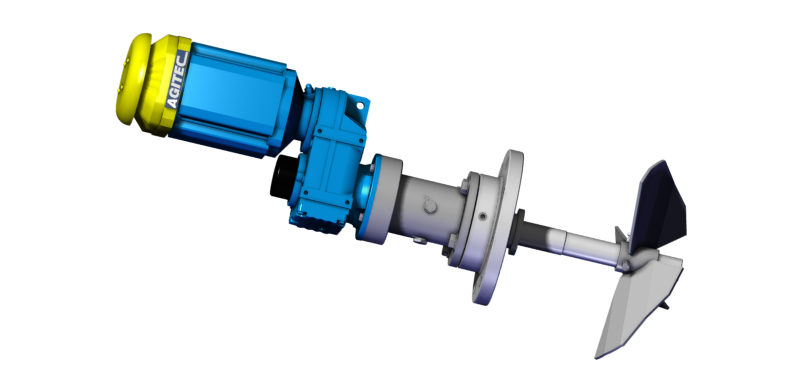
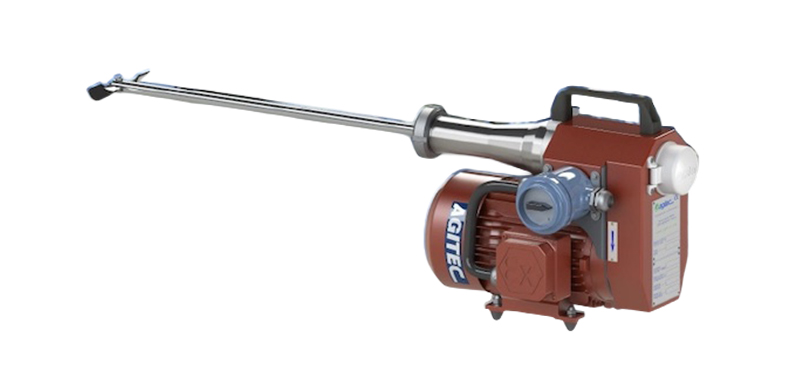
The horizontal position of an agitator, installed on a vertical axis tank, is mainly associated with the maintenance phases (homogeneous, suspension) encountered in industry on storage tanks or buffer tanks. As for mixers, this position is optimal for mixing high-viscosity products with complex rheologies in horizontal axis containers.
How a horizontal mixer works
One or two rotating shafts stir the material in a radial flow. The intense movement allows for rapid shearing, which is effective for semi-solid or pasty mixtures. This operation is based on the synchronised rotation of arms equipped with blades, which create dynamic agitation throughout the entire volume. The distribution of movement in the tank allows for homogeneous diffusion of loads, even in the presence of dry materials or fluids with high density and/or viscosity. This principle is particularly suited to continuous cycles.
How a horizontal agitator works
A horizontal agitator is particularly used for vertical storage tanks or buffer tanks. Its function is to maintain suspension or maintain the homogeneity of a mixed fluid upstream. This step prevents stratification and deposits before product packaging, as well as phase separation in the absence of agitation. A horizontal agitator is equipped with a single or double lubricated mechanical seal, depending on the process constraints, and typically with an AX1 type mixing propeller.
Industrial applications
Double-shaft mixers are used, for example, in the manufacture of concrete, high-density products with a high fibre content, or ready-to-use coatings: adhesives, resins or mastics. A horizontal agitator can be used in food and beverage temperature maintenance applications by fruit juice and dairy manufacturers.
Compare the positions of industrial mixers and agitators
An objective comparison between positions allows you to quickly identify the technology best suited to the process. Each configuration is adapted to a specific fluid profile, tank architecture and production environment.
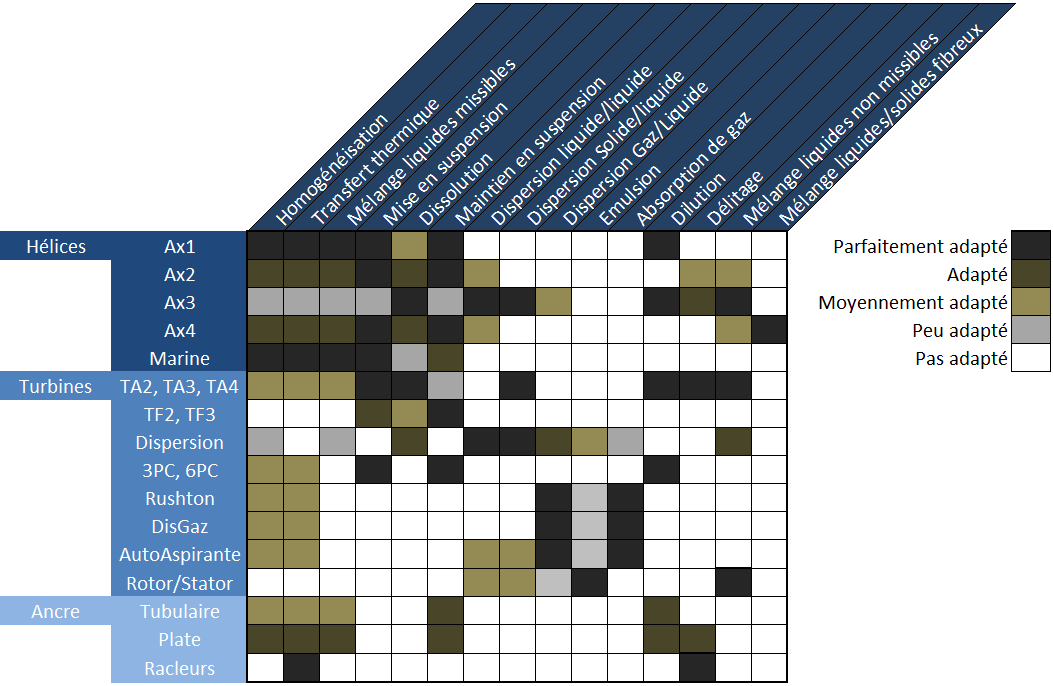
Comparison table of vertical, horizontal and pendulum configurations
| Position | Fluid type | Footprint | Maintenance | Areas of use |
|---|---|---|---|---|
| Vertical/pendulum |
Clear/miscible liquids
Fragile, unstable
|
Highly variable | Optimised | Cosmetics, pharmaceuticals, biotech, chemicals |
| Horizontal | Pastes, clear or thick liquids | Reduced | Accessible | Agri-food, construction products |
Selection criteria for a suitable installation
The choice is based on several parameters: product viscosity, cycle time, operating conditions, production rate, tank accessibility and applicable standards (ATEX, FDA, CIP). An upstream assessment guarantees the performance of the installed system.
Specific standards and environments
The three positions are available in ATEX agitator, clean-in-place or sterile environments. While pendulum agitators are suitable for special tanks, horizontal mixers are integrated into specific containers designed to enclose the mixing tools. These two elements are inseparable. Horizontal agitators, like pendulum agitators, are suitable for different types of tanks with height/diameter ratios greater than 2.
Technical outlook: innovations and trends
AGITEC® designs, manufactures and adapts industrial agitation solutions designed to meet all the constraints of all types of industries. Each configuration — vertical, horizontal or pendular — is designed in accordance with the characteristics of the fluids, process constraints, tank volumes and mixing performance objectives, while optimising energy consumption.
Tailor-made expertise and continuous innovation
At AGITEC®, our mechanical and fluid mechanics engineers are experienced and have expertise with our customers. This expertise allows them to adapt each agitation system to the most complex environments.
French production, industrial responsiveness
Thanks to its production facilities based in France (Auvergne Rhône-Alpes region), AGITEC® guarantees complete control over the quality, delivery times and longevity of its agitators. Each vertical/pendular or horizontal mixer or kneader is designed in close collaboration with the end user in order to perfectly meet their specifications.
Mixing tools developed in the laboratory
Each agitator agitation has been entirely defined and calculated by our R&D engineers in our testing laboratory. The precise definition of the agitator ensures perfect compatibility with each application.