

Industrial dispersers: precisely controlling the various dispersions between solids, liquids, and gases
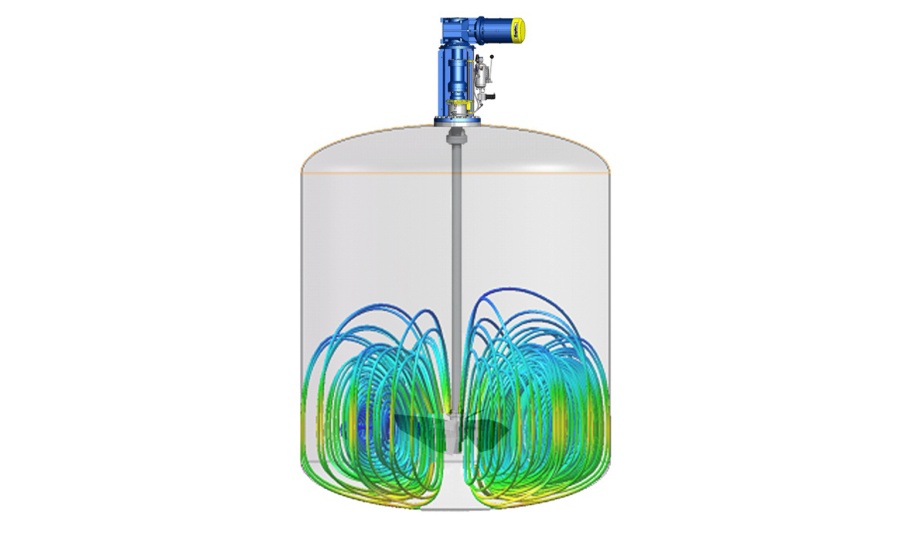
The disperser is an essential tool for any production unit involving the mixing of distinct phases: liquid, solid and/or gas. Thanks to their capacity to process volumes ranging from a few litres to several hundred cubic metres, industrial dispersers meet the most stringent requirements in terms of viscosity, stability, grinding and emulsion performance. Control of shear, speed and flow diffusion determines the final quality of a product.
Production dispersers are designed for a variety of applications ranging from varnishes to pigments, from cosmetic grinding to industrial paint. They can be supplied for a single application or for integration into complete lines. Today's market demands highly energy-efficient solutions with perfect shear control, rapid peripheral speed increase and excellent manufacturing reproducibility.
AGITEC® is part of this dynamic with a wide industrial range designed to ensure perfect control of every application, from small pre-industrialisation volumes to large-scale production.
Defining industrial dispersion: principles and purposes
Dispersion is the fine incorporation of one phase into another. It differs from simple mixing in terms of the intensity of the shear, the fineness of the grinding and the stability of the suspension obtained. Industrial dispersers are used when the objective is to ensure the homogeneous distribution of particles, droplets or bubbles in a carrier liquid.
This process is used in the formulation of paints, varnishes, creams, resins, adhesives and inks. It relies on intense mechanical action: high speed applied to a dispersing disc mounted on a shaft driven by a motor of adjusted power. The energy transmitted to the product breaks down agglomerates and promotes the humidification of powders or the emulsion of immiscible liquids.
Read our article in the Journal des Fluides on the acrobatic installation of a MEGA-paint disperser
The equipment can operate under vacuum, under pressure or at atmospheric pressure. It is designed to handle highly variable volumes: from a disperser of approximately 20 litres to one of 50 m3. It is also available in an ATEX (explosive atmosphere) version or in an ultra-clean version for pharmaceutical applications (aseptic environment).
Overview of the main types of dispersion
Industrial dispersion covers three main types of configurations, depending on the nature of the phases to be processed. This typology determines the choice of rotor, motor power and tank size.
| Phase medium | Dispersed phase | |||
|---|---|---|---|---|
| Gas (bubbles) | Liquid (droplets) | Solid (solid particles) | ||
| Continuous medium | Gas | None | Liquid aerosol | Solid aerosol |
| Liquid | Foam | Emulsion | Suspension | |
| Solid | Solid foam | Solid gel or emulsion | Solid suspension | |
Solid/liquid dispersion: breaking up agglomerates
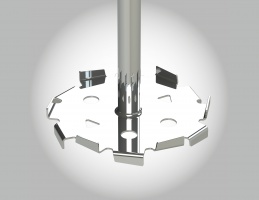
This type of dispersion aims to break up solid particles in a liquid, while preventing them from settling. It is commonly used in paints, pharmaceutical powders and pigments. The equipment often includes a dispersing disc, toothed blades and an adjustable peripheral speed of up to 25 m/s.
AGITEC® adapts its configurations according to the target particle size, the sensitivity of the materials and the viscosity of the carrier liquid. Specific turbines ensure perfect homogeneity even in high volumes.
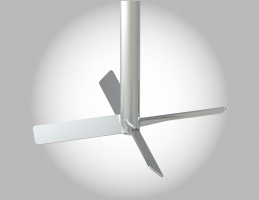
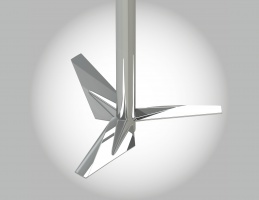
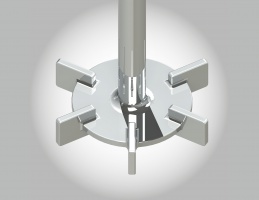
Examples of agitators suitable for solid/liquid dispersion
Liquid/liquid dispersion: homogenizing fluid phases
Liquid/liquid dispersion involves mixing two liquids with different viscosities, which may be immiscible. It is used in perfumery, fine chemicals, and food flavoring processes.
The rotor-stator is mainly used for immiscible liquids, ensuring high shear without excessive heating. Controlling the temperature and dispersion time allows an ideal balance to be achieved between the continuous phase and the dispersed phase. AGITEC® offers a range optimized for sensitive mixtures and fine loads.
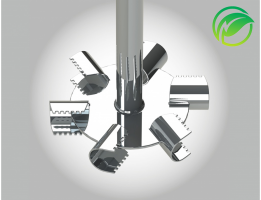
Examples of mobiles suitable for liquid/liquid dispersion
Gas/liquid dispersion: microbubbles and mass transfer
Gas/liquid dispersion involves introducing a gas (air, nitrogen, CO₂) in the form of fine bubbles into a liquid. It is essential in biotechnology and agri-food.
Rushton turbines, self-aspirating turbines, and Disgaz systems developed by AGITEC® provide excellent gas residence time, reduced bubble size, and optimal gas/liquid transfer. These solutions can be integrated into vacuum or controlled atmosphere tanks.
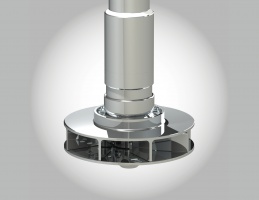
Examples of devices suitable for gas/liquid dispersion
Gas/liquid/solid dispersion: promoting complex multiphase reactions
Gas/liquid/solid dispersion under agitation involves effectively mixing three phases: a gas (often air or a reactive gas), a liquid (the reaction medium), and solid particles (catalysts, fillers, etc.) to ensure optimal mass and heat transfer. This type of dispersion is essential in multiphase processes such as hydrogenation.
It requires an agitator designed to generate high turbulence, promote local shear, and keep solids in suspension while maximizing gas dissolution in the liquid. It is often used in reactive chemistry to promote heterogeneous catalytic reactions.
Disperser, emulsifier, grinder: clarifying the technologies
Several types of equipment coexist in workshops: dispersers, emulsifiers, and grinders. They differ in terms of the level of shear, the nature of the flow, and the type of product being processed.
The disperser works in immersion, with a rotating toothed head. The emulsifier uses its air gap to adjust the size of the particles generated by the rotation in the stator of the shearing tool. The mill, meanwhile, incorporates balls or abrasive elements to micronize the particles to sizes smaller than a micron.
AGITEC® assists professionals in choosing the right system for the desired result: rapid dispersion, particle reduction, colloidal stability, or controlled deaeration.
Criteria for selecting an industrial production disperser
A high-performance production disperser must be chosen according to the specific characteristics of the product and the process.
Technical parameters to be taken into account:
- Fluid viscosity (from 1 cP to 100,000 cP)
- Operating conditions
- Size and nature of the solids or liquids to be dispersed
- Tank volume (pilot or production)
- Desired peripheral speed (up to 25 m/s)
- Cleaning constraints: CIP/CIP, manual access
- ATEX environment or not
Shapes and integration:
- Vertical disperser mounted on a column or mobile frame
- Version mounted on a fixed tank or reactor
- Vacuum disperser for sensitive materials
- Complete skid-mounted equipment for formulation lines
AGITEC® designs scalable solutions that can be adjusted at each stage of industrial development.
Zoom applications: sectors concerned by dispersion
Industrial dispersion is used in many key sectors, with very specific requirements in sectors such as:
Cosmetics and pharmaceuticals
- Preparation of creams, lotions, mineral pigments, dispersion of hydrophilic or lipophilic active ingredients, gentle grinding in sterile tanks, FDA/ATEX compliance.
Paint and inks
- Pigment stabilization, grinding of fillers, dispersion of colored additives, viscosity control, reduction of air bubbles.
Food
- Formulation of sauces, mayonnaise, syrups, dissolution of thickeners, vacuum treatment to prevent oxidation.
Industrial chemistry
- Emulsions, hydrogenation with catalysts, polymerization, extracts, solvents, temperature control, integration into closed-loop reactors.
Water treatment
- Polymer dispersion, reagent incorporation, controlled oxidation, robust and easy-to-clean equipment.
AGITEC®: a tailor-made solution for every dispersion need
AGITEC® develops industrial dispersers suitable for four types of dispersion: solid/liquid, liquid/liquid, gas/liquid, and multiphase (gas/liquid/solid). Thanks to its strong engineering capabilities, the company designs robust, configurable solutions tailored to each professional use.
The equipment is available in pilot and industrial formats, with comprehensive support from design to commissioning. The systems are optimized to operate in tanks, under vacuum, in batch or continuously.
Each AGITEC® disperser guarantees high manufacturing quality, proven process repeatability, and excellent integration into existing production lines.