

Mixer, agitator, disperser: choosing the right industrial agitation system
Mixing, homogenizing, dispersing, or maintaining suspension requires precise control of the interactions between fluid, mechanical energy, and equipment configuration. Regardless of the industrial process, the performance of the processes depends on the efficiency of the agitation system. In the field, confusing a mixing effect term can compromise the quality of the result obtained.
Professionals in the food, chemical, cosmetics, pharmaceutical, and water treatment industries must clearly state their requirements so that the agitator manufacturer can select the agitation technology best suited to their constraints (viscosity, cleanability, space requirements, and speed). Agitec® offers you a clear and technical overview to guide this strategic decision.
Key definitions of industrial agitation, mixing systems, and homogenization technologies
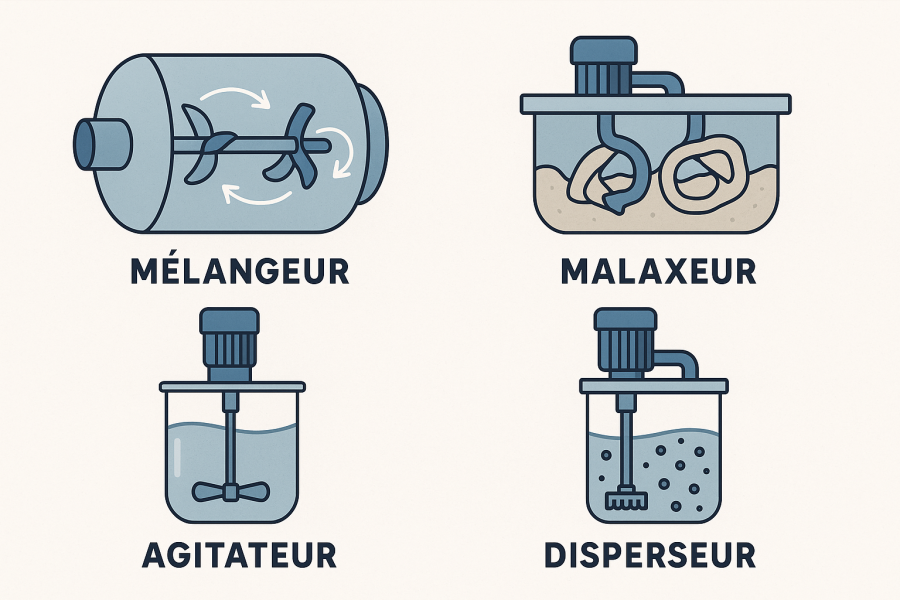
Agitation processes cover several families of equipment, each with a specific functional purpose. Being able to distinguish between an agitator, a mixer, and a disperser ensures that the chosen technology is well suited to industrial production constraints.
The agitator is a dynamic device consisting of a motorized shaft and an immersed mixing element. It generates a circular motion in a fluid, allowing its temperature, concentration, or structure to be homogenized.
There are three configurations:
- Tank roof: used in mixing or reaction tanks
- Tank bottom: compact solution suitable for confined spaces
- Side: often chosen for large-volume storage tanks
Discover our article dedicated to the orientation of agitation systems.
Areas of application include biological water treatment, fermentation, cosmetics production, and chemical synthesis. Available motors range from 0.18 to over 300 kW, with speeds from 20 to 1500 rpm depending on the size of the tank and the viscosity of the fluid.
Static mixer, consistency without maintenance or motor
The static mixer is distinguished by its lack of moving parts. It consists of a tube through which fixed internal elements pass, forcing the fluids to mix by division and recombination.
It is installed directly in the process lines. It is suitable for liquid/liquid, liquid/gas mixtures, or continuous chemical reactions. The MS-TOR, MS-HIGH SHEAR, and MS-ELLIP models are designed for different mixing effects and shear rates.
There are many advantages:
- Quick installation using standard fasteners (clamp, SMS, ISO flange, etc.)
- No motor or maintenance
- Controlled pressure drops
High-speed disperser, shearing and fine dispersion
The disperser allows one phase to be incorporated into another thanks to a high shearing effect. It is used to deagglomerate powders, reduce particle sizes, or form emulsions on immiscible liquids.
The toothed disc creates a very high-speed tangential flow, between 1,000 and 6,000 rpm (speed related to the size of the dispersion tool). This system requires rigorous control of temperature and cycle time to prevent product alteration. Applications include inks, paints, creams, cleaning products, and additives, among others.
Discover our article dedicated to industrial dispersers.
Industrial mixer with high motor torque for paste-like mixtures
The mixer processes high-viscosity products. Unlike the agitator, it operates at low speed but with high torque. It is used for adhesives, cements, food pastes, and paste-like pharmaceutical products.
The most common models are:
- Helical ribbon
- Double horizontal shaft
- Planetary with fixed bowl
The torque can exceed 1000 Nm. These machines operate in batch mode. Cleaning often requires partial disassembly.
Technical criteria for choosing an industrial agitation system
The choice of an agitator or mixer depends directly on the characteristics of the fluid and the expected result. Here are the main criteria to consider:
- Viscosity: a liquid at 1 cP (water) is not treated in the same way as a paste at 800,000 cP
- Type of mixture: homogenization, suspension, emulsion, dispersion
- Tank structure: height, diameter, presence of counter blades, access from above or below
- Industrial environment: all types of environments including ATEX zones, required sterility, CIP cleaning, etc.
- Maintenance: optimized disassembly depending on the criticality of the installation
Summary comparison table of agitation technologies :
| Equipment | Type of fluid | Main function | Speed | Maintenance |
|---|---|---|---|---|
| Conventional agitator | Low-viscosity liquids | Homogenization, simple dissolution, suspension | 60 to 1500 rpm | Medium |
| Static mixer | Clear liquid | Continuous homogenization | No rotation | None |
| Mixer | Pasty product > 50,000 cP | Intensive mixing | 5 to 60 rpm | Strong |
| Disperser | Dispersed or loaded fluid | Dispersion, emulsion | 1000 to 6000 rpm | Regular |
Agitation technologies: focus on propellers, turbines, rotors, and anchors
The choice of agitation device directly influences the quality of the mixture. Some configurations favor flow, others favor shearing or scraping. This section explains the main technologies used to finely tailor agitation to specific needs.
Propeller, turbine, and anchor agitators: from laminar to turbulent flow
Propeller agitators are effective for mainly axial flows. Their high volumetric efficiency makes them suitable for suspension or heat exchange, for example.
The latest generation of DisGaz turbines (equivalent to Rushton) are preferred for gas/liquid dispersions, creating intense shearing at the blade tips and a stabilized vortex effect.
Anchors, on the other hand, are used for mixing viscous products in cylindrical tanks. Their function is often associated with scraping the walls.
In-line static mixers: performance and simplicity
In high-flow environments with little human intervention, static mixers are the obvious choice. They are frequently used in:
- Wastewater treatment plants (reagents, flocculants)
- Chlorination units
- Continuous dosing installations in chemistry
Their longevity and hydrodynamic stability allow for exemplary repeatability.
High-shear dispersers: precision formulation
Modern dispersers can be integrated into both mobile tanks and controlled installations. They enable the micronization of solid phases, the stabilization of suspensions, and the preparation of homogeneous creams. In cosmetics and pharmaceuticals, they ensure essential batch-to-batch reproducibility.
Special mixers for sensitive or abrasive products
Some mixers are designed with non-stick coatings or reinforced materials to withstand abrasive loads. Other models are equipped with temperature or torque sensors for better cycle control.
Typical industrial applications: food processing, chemicals, water, cosmetics
Each industrial context requires specific technology. Several concrete and common applications illustrate this diversity
- Food processing: juice mixing, alcoholic fermentation, sauce or dessert cream formulation
- Cosmetics/pharmaceuticals/biotechnology: pigment dispersion, cream stabilization, multi-phase emulsions, perfume maturation, cell cultures.
- Chemicals: acid/base neutralization, polymerization, precipitation, resin production
- Water treatment: flocculation, mixing of reagents, sludge suspension
- Nuclear: agitation in shielded tanks, precision dosing
The repeatability of recipes and the time required to obtain results are the dominant criteria in these sectors.
Energy efficiency and developments in different agitation systems
Choosing the right agitation system means combining mixing performance, embedded technology, controlled energy consumption, and production reliability. Each technical solution has its own area of excellence depending on the rheology of the products being mixed, the shape of the container, and the process objective.
Changing regulatory requirements, the rise of clean processes, and the digitization of production lines are driving the need for more connected and predictive equipment. Solutions controlled by variable speed drives or PLCs now make it possible to optimize agitation in real time.
AGITEC® offers support from the specification stage onwards to validate the sizing, configuration, and compliance of the equipment in order to precisely meet the needs of the application.